
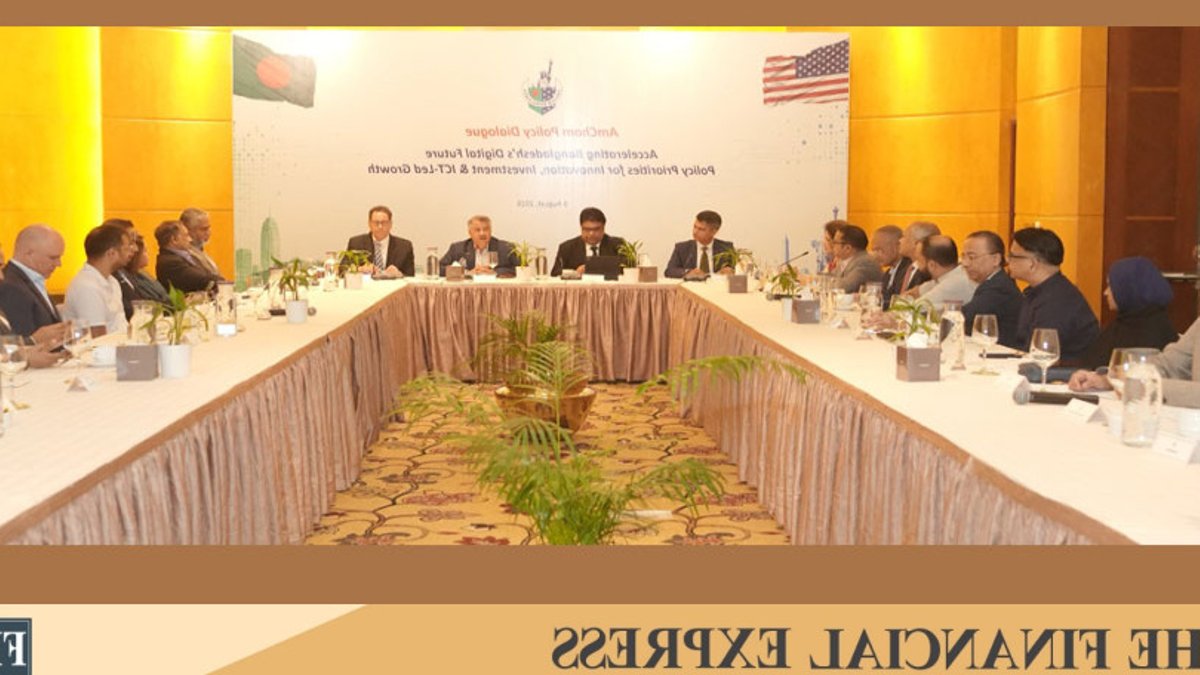
AmCham’s recent policy dialogue highlighted a series of initiatives aimed at shaping Bangladesh’s digital future, with a focus on innovation, cybersecurity, and efficient governance.
Government and Business Leaders Discuss Policy Priorities
At the Westin Dhaka on August 9, 2026, the American Chamber of Commerce in Bangladesh convened senior officials and industry executives to outline policy steps for accelerating ICT‑led growth. The event’s chief guest, Rehan Asif Asad, Advisor to the Prime Minister on Post, Telecommunication, ICT, Science and Technology, presented five priority areas for the sector.
First, the government pledged a stable, five‑year tax framework, noting the telecom industry’s current effective tax burden of 51‑56 % compared with a global average of 22‑27 %. The removal of the SIM tax was also mentioned.
Second, officials highlighted the need to improve mobile and broadband connectivity, citing Bangladesh’s rank of seventh worldwide for subscriber numbers but acknowledging gaps in service quality.
Third, a “One Citizen, One ID, One Digital Wallet” platform—built on Estonia’s X‑Road system—will be offered at no cost, linking every national ID to bank accounts and the National Board of Revenue.
Fourth, the plan calls for AI‑ready talent, integrating cybersecurity and data skills into curricula for the 23,000‑30,000 engineering graduates each year.
Finally, the government aims to boost electronics manufacturing with incentives modeled after the garment sector, referencing Vietnam’s rise from $1 billion to $217 billion in consumer‑electronics exports over a decade.
During the dialogue, Syed Mohammad Kamal, President of AmCham and Vice President of Mastercard, thanked the government for ratifying the Personal Data Protection Act (PDPA) and welcomed tax exemptions for freelancers and content creators, as well as customs relief on computers and semiconductor‑related materials.
Related: Wealthy young investors bet big on luxury assets
Industry Concerns and Recommendations
Representatives from Citibank, Cisco, HSBC, Mastercard, MetLife, Pathao, PwC, Standard Chartered, ShopUp, Visa and other firms raised specific issues. They advocated for open‑loop ticketing for metro and toll systems, and a correction of a 15 % VAT waiver under the NBR Startup Sandbox, which they said could create anti‑competitive effects.
Participants also called for alignment of cloud policies for banks and non‑bank financial institutions with the PDPA to permit public‑cloud use, the early formation of a National Data Governance Authority, and the enablement of digital signatures and enforceable electronic agreements.
Cybersecurity was a recurring theme, with industry leaders urging stronger national defenses and a faster closure of the AI and data‑engineering talent gap through collaboration between companies and academic institutions.
In response, the chief guest confirmed that RFID‑based toll collection is being trialed, and adjustments to the Startup Sandbox provisions will be made after consulting the broader startup community.
From a practical standpoint, the need to expand submarine cable capacity is urgent. Current capacity sits at six terabytes, while peak national demand has already reached 12 terabytes, and traffic is expected to double every two years. New submarine cables typically require two to three years to deploy, making them a cornerstone of the country’s digital sovereignty.
The dialogue highlighted strong government commitment, but the pace of implementation will determine whether Bangladesh can translate policy into measurable economic gains.
Growth will likely hinge on how quickly infrastructure upgrades and regulatory adjustments can keep up with the rapid evolution of technology.
The session concluded with a vote of thanks from Ala Uddin Ahmad, Vice President of AmCham and CEO of MetLife Bangladesh, and highlighted the continued support of partners such as Cisco.


Leave a Reply