
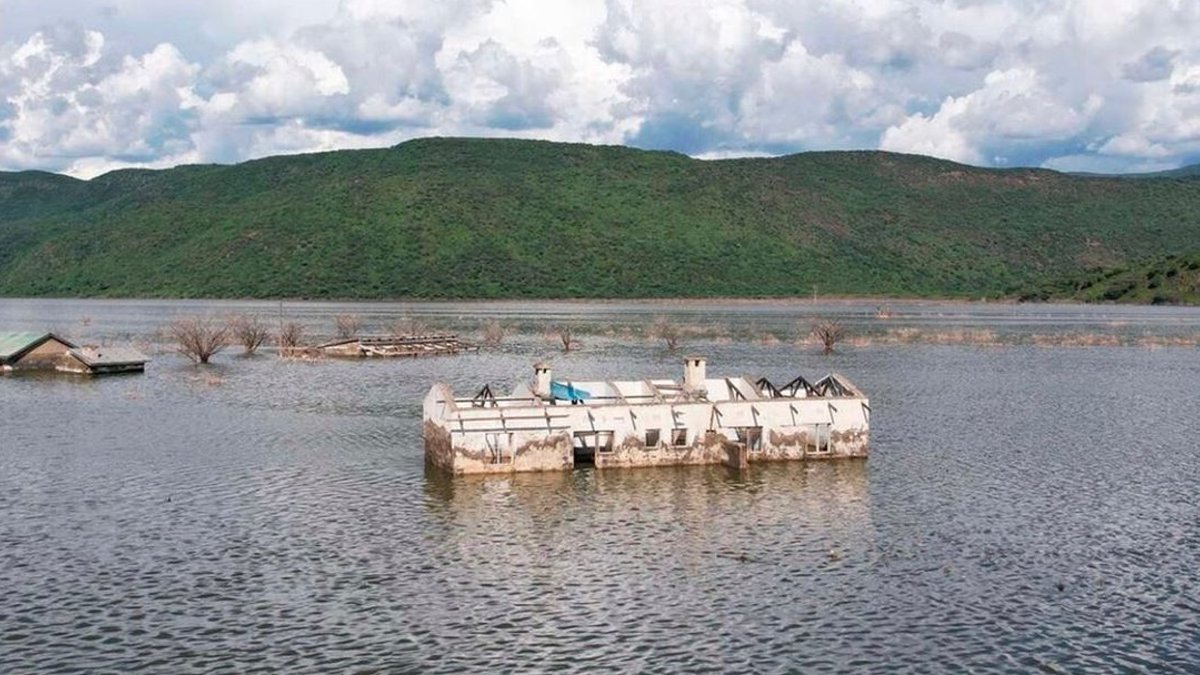
The ecological crisis unfolding in Kenya’s Rift Valley has intensified as Lake Bogoria and Lake Baringo edge closer to merging, separated now by less than three kilometers. Government officials have declared this an emergency, emphasizing that a merger would destroy the distinct chemical compositions sustaining each lake’s delicate balance. Lake Bogoria, a saline body, has steadily advanced toward villages like Loboi in Baringo South over the past decade, flooding farmland and displacing families. Jones Lewatchum, who has moved three times since 2012, now lives in a tent after losing his ability to farm or keep livestock. The lake has also submerged the old Loboi Health Clinic, pushing residents farther from their ancestral lands.
Lake Baringo, Kenya’s only freshwater lake in the region, has risen by 12 to 14 meters in the last 15 years, expanding its surface area from 108 to 130 square kilometers. With no natural outlets, excess water from both lakes has only one direction to flow: toward the shrinking gap between them. If they merge, Baringo’s freshwater ecosystem could clash with Bogoria’s alkaline waters, endangering flamingo populations, geothermal springs, and rare plant species that rely on each lake’s unique chemistry.
Read Also: New Tax Break for Founders in 2026 Budget
Defense Principal Secretary Patrick Mariru warned that the lakes are “on the verge of merging” without intervention, describing the potential merger as an irreversible ecological disaster. The crisis has already forced over 600 households from their homes, including Bakulutu, who lost farms and businesses. In Mogotio Constituency, underground water broke through in May, flooding 250 acres overnight and isolating roads, such as the Marigat-Loruk route. The local dispensary had to relocate, leaving no secure location to store anti-venom in an area prone to snakebites.
The government has proposed a major solution: diverting excess water through tunnels and canals to irrigation projects covering at least 100,000 acres in Baringo and Turkana County. This plan, led by Mariru and Irrigation Principal Secretary Ephantus Kimotho, would repurpose floodwater for agriculture under a private investment model. Researchers, including Professor Simon Onywere, have also suggested an alternative approach: redirecting the Waseges River into Lake Baringo instead of Bogoria, then channeling Baringo’s overflow toward the Suguta Valley. Feasibility studies for both methods are currently being conducted.


Leave a Reply