
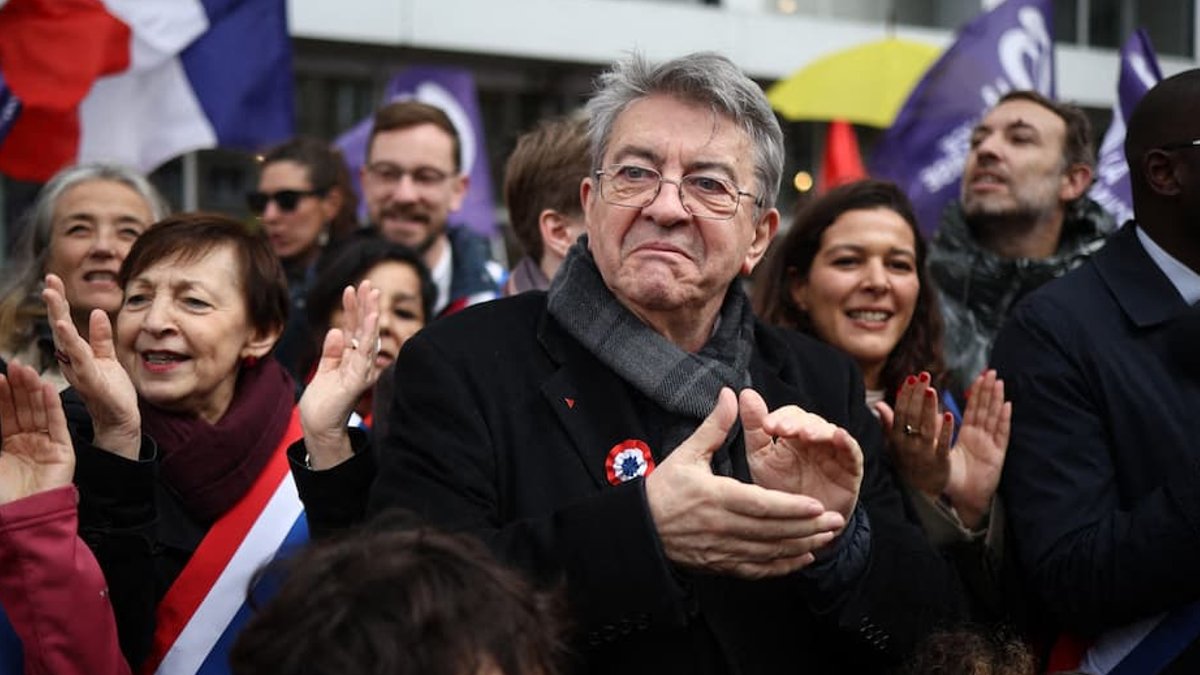
The French diplomatic corps in the Maghreb region is bracing for a period of isolation. According to local reports, the far-left party, La France Insoumise (LFI), is expected to achieve a record score in the 2027 presidential election, with 86.05% of the vote in Algeria, 71.55% in Morocco, and 80.42% in Tunisia.
The Algerian press has been praising Jean-Luc Mélenchon, affectionately referring to him as “Méluche.” His promise of a “Grand Soir” for the French people resonates with some in the region, who see it as a return to the fourth republic, a time of great social change in France.
A retired Algerian who lived through the country’s tumultuous decolonization period notes that LFI’s rhetoric reminds him of the “good old days” when France was in retreat. However, not everyone in the region shares this enthusiasm for Mélenchon and his party.
Read Also: Former GIGN Chief Shares Leadership Lessons in New Book
Divided Opinions
Locals who support Mélenchon are largely composed of teachers, retirees, and administrative personnel who have lived in the region for an extended period. They responded to his 2019 call to French citizens of immigrant descent to express themselves in the voting booth. Mélenchon’s message has remained consistent: “There cannot be two kinds of French people.”
The vote of Maghrebi dual nationals accounts for around 4% of the total votes cast. This bloc of votes will be significant in the second round of the presidential election, particularly if Mélenchon faces off against Marine Le Pen.
However, many in the region are put off by LFI’s stance on issues like visas, social aid, and redistribution. The party’s perceived ambiguity on urban violence has shocked some in Morocco, where order and security are highly valued. A shopkeeper in Casablanca comments, “Your young people want work, but they don’t respect other people’s work.”
In Algeria, the disapproval is directed at LFI’s strategy of “conquering chaos.” During the Hirak protests from 2019 to 2021, Algerian demonstrators made a point to avoid damaging property and even organized cleaning services after their rallies. For these men and women who have braved a regime far more brutal than Macron’s, witnessing LFI’s followers vandalize public spaces or seeing children of the diaspora burn cars and buses feels like an insult—an affront to those who took real risks to defend their freedoms and ideas.
Read Also: French lawmakers propose legalizing embryo screening for IVF
Bad Memories
In contrast to French voters who have been influenced by Mitterrand’s leftist ideology, the Maghreb region has a long history of experiencing the violent side of the far left. Morocco faced an insurrection in 1973, while Tunisia battled Marxist and Maoist organizations. Algeria’s economy was also severely impacted by collectivization and nationalization, policies that LFI’s program defends.
Mélenchon’s lack of understanding of the left beyond the “poetry of the barricades” might have been overlooked if he hadn’t crossed the line into issues of religion. On issues like poverty, LFI’s stance is at odds with Islamic tradition, which views wealth as legitimate and encourages the wealthy to support the poor without apologizing for their riches.
The other point of contention is the party’s proximity to Islamist organizations. Despite LFI’s denials, a 2025 parliamentary inquiry confirmed this proximity. This has offended many in the region, who see it as an attempt to co-opt Muslim voters. A scholar in Tunis remarks, “Since when is the Koran associated with leftist ideas? It’s insulting!”
Read Also: French right wing candidates discuss subsidiarity at Paris event
The strategy of flattering Muslim voters has backfired, with many feeling humiliated by being lumped together with other minority groups. On one hand, dual nationals see Mélenchon as a necessary evil to normalize Islam in France; on the other hand, people in the Maghreb question this pact, which they see as contrary to their beliefs. The people in the region have strong convictions about their faith and its role in society.
The region is dominated by strong regimes with clear ideas. His discourse becomes unclear when faced with divisive issues, such as transsexuality, which is highly sensitive in the region. LFI’s defense of hormone treatments for minors while opposing “certain” transition interventions has raised questions, with a Moroccan high school student asking, “Why certain ones?”
Regional Concerns
In Morocco, the classes are often very pious, and no one can explain why young people from the neighborhoods who claim to master Arabic support Mélenchon, who presents himself as the champion of secularism.


Leave a Reply